After a spate of paranormal sightings in 1970s London, debate raged over the existence of a vampire in Highgate Cemetery. Fifty years on, the legend has been taken on by a new generation, fuelled by the world’s longest-running online feud
Jamie Farrant has come to understand something most people never will: what it means to be the son of a vampire hunter.
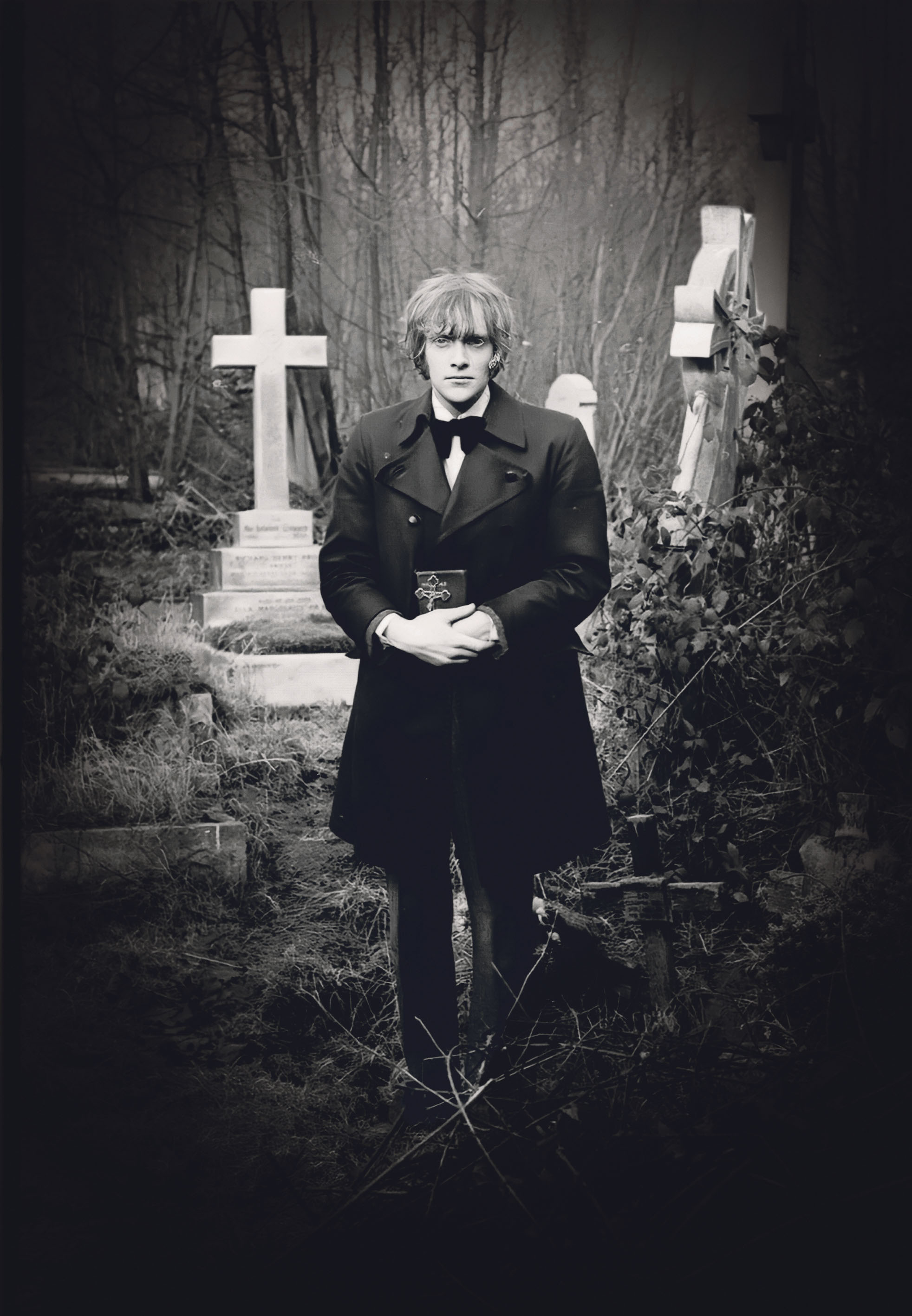
The middle-aged docker arrived at this knowledge by chance 16 years ago. One day, he was Jamie Farrant, the fatherless boy who had spent half a lifetime wondering about the mystery of his origins. The next, he was sitting in his house on the fringes of Southampton on a dank afternoon in early 2010, staring hard at some images on his computer screen. They showed a rake-thin, scraggly haired man clad in an array of dandyish outfits. The oldest black-and-white photos depicted a fey-looking figure in his 20s, clutching a bible to his chest in an overgrown north London graveyard.
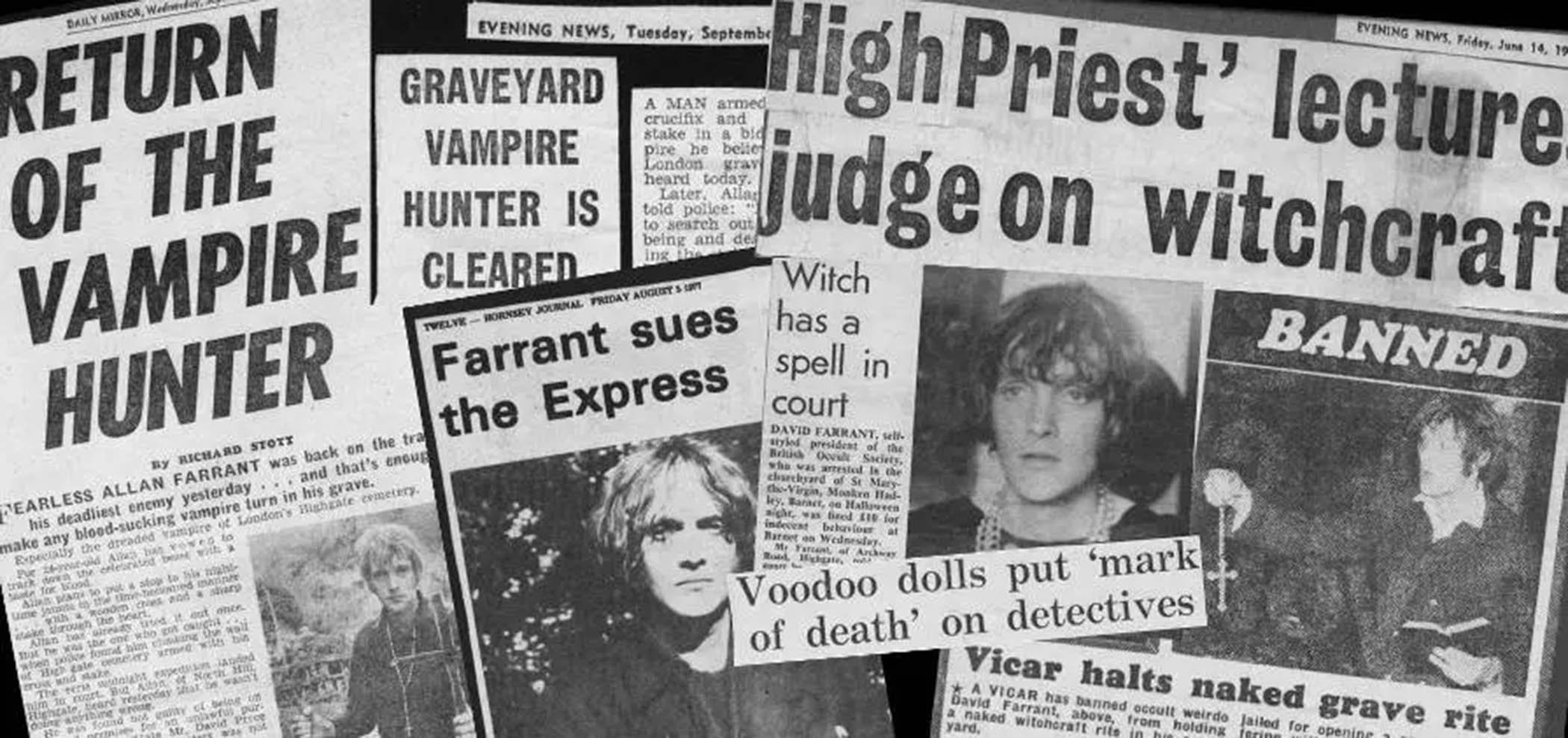
The first thing his estranged son noticed was a name: David Farrant. Then came the undeniable strength of their facial resemblance. Then Jamie turned to the many hundreds of news articles linking David Farrant to the Highgate vampire, one of the 20th century’s most enduring occult legends.
Growing up on the south coast, Jamie Farrant had often daydreamed about the sort of man his long-absent father would be. Paternal yearnings aside, his upbringing had been reasonably content, spent with his mother, stepdad and younger brother. Before Southampton, the infant Jamie and his mother had also lived in north London, in a one-bedroom flat between Highgate and Muswell Hill. “I was about 18 months old when she said: ‘No, that’s enough of that.’ [She] left when things started to get weird,” he told me during one of our many meetings over the last two years. “She said she’d caught the milk train out and never looked back.”
During his childhood and adolescence, his mother had declined to speak about his father’s identity. Not long after his 18th birthday, however, he had an intriguing conversation with his uncle. Oh yes, he remembered Jamie’s father very well. He had been all over the national press. “I sort of thought it was a joke,” Jamie told me.
After that, the flare-ups of curiosity came and went. From an early age, he had harboured an interest in the paranormal. Ghosts and supernatural beings, werewolves and ghouls: he enjoyed the quiet feeling of trepidation these tales provoked. In early 2010, he’d picked up a history of Britain’s best known cases. By chance, his girlfriend also had the same book at home. “We read the [chapter] about the Highgate vampire and [saw] the name David Farrant. I thought: ‘I wonder if this could be my dad.’ I asked my mum and she confirmed it. So I found his website and sent him an email.”
Weeks later, Jamie was standing at the entrance to a block of flats in Muswell Hill, trying to suppress the nerves in his stomach. “I knocked on the door and waited. His flat was on the top floor. [Eventually,] I saw this shadowy figure getting closer to the front door. Then it opened and we shook hands. I followed him up the stairs and he made a cup of tea. Then we got talking – and that was it. One minute I didn’t know him, and then there he was.” Even after a lifetime of absence, it didn’t take long for the Highgate vampire to dominate their conversation. It would do so for most of the next decade. The joy and disbelief of reconnection has occasionally given way to more troubled stirrings. “Bloody hell,” Jamie has often had cause to think. “What have I uncovered here?”
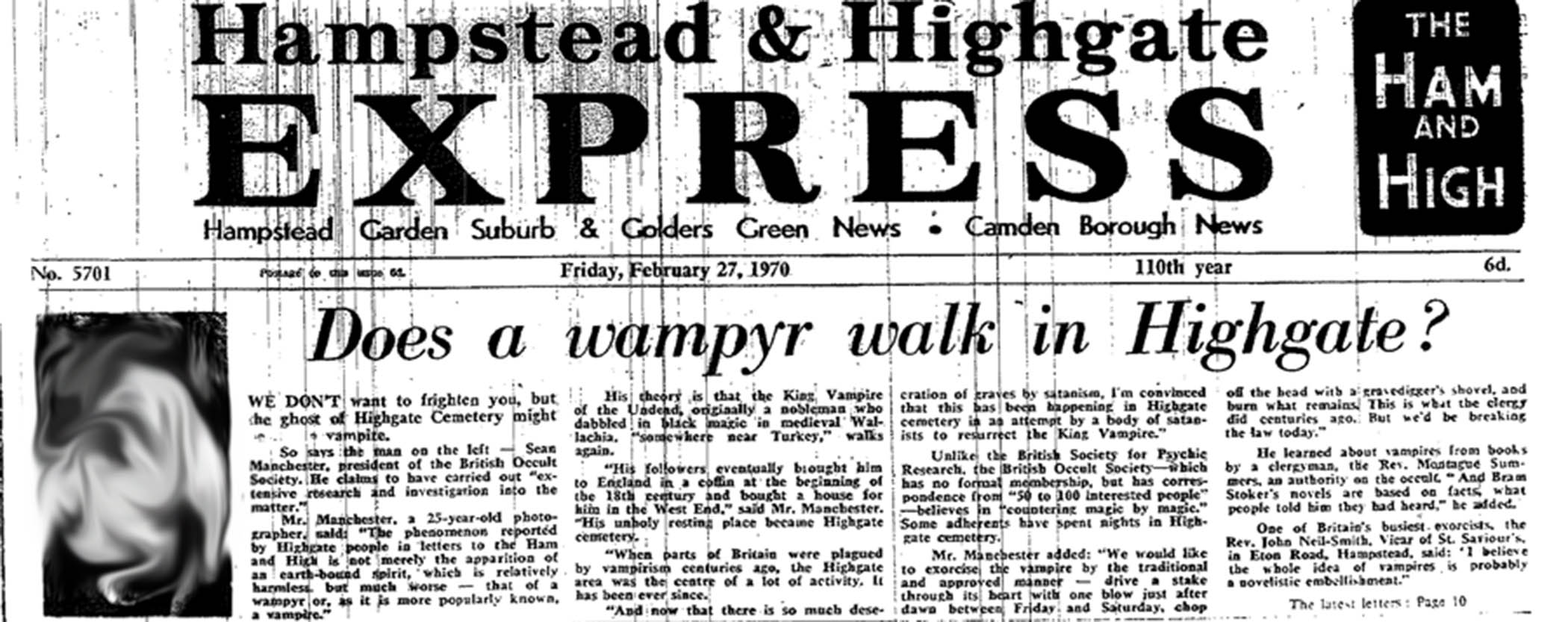
On 27 February 1970, the Hampstead & Highgate Express ran a front page guaranteed to concentrate the attention of the residents of north London. Headlined: “Does a wampyr [sic] walk in Highgate?”, the accompanying article offered a bold explanation for a spate of paranormal sightings in and around Highgate Cemetery over the previous two and a half years.
In 1967, two teenage girls walking home along nearby Swains Lane claimed to have witnessed the dead rising from their graves by the cemetery’s north gate. Another young woman had woken one night with “something cold and clinging” on her hand that left prominent marks the next morning. Further reports mentioned a “tall man in a hat” wandering through the streets, before melting through the cemetery’s thick stone walls.
If today Highgate is associated with A-list actors and sanctioned Russian oligarchs, it was not always so. In the late 1960s, London was in a downward spiral, hastened by population decline and physical decay. Blitz-era ruins were still visible across the city. London’s graveyards were in particularly poor condition.
Nowhere was this more pronounced than Highgate Cemetery. Built at great public expense in the 1830s, it was the grandest of what became known as the capital’s “magnificent seven” cemeteries created to accompany Victorian London’s population boom. When the cemetery’s parent company fell into financial difficulties after the Second World War, its upkeep declined.
In the 1970s, its shabby Victorian mausoleums and picturesque, overgrown gravestones spoke to the cultural moment. Folk horror was in its pomp, with the release in 1973 of The Wicker Man and the relentless churn of Hammer horror films, several of which were shot in Highgate Cemetery.
Prof Ronald Hutton has spent his career studying the British occult. This was, he explained, also the first age of counterculture. “The struggle to exist [experienced by] the previous generations … is suddenly gone into this brave new world. [And] what happens at Highgate is an unusual and rather bizarre manifestation of hippy counterculture.”
At the beginning of 1970, dead animals had been discovered in and around Highgate Cemetery. Their carcasses had allegedly been drained of blood. On 6 February, David Farrant – the son of a local tobacconist, then in his mid-20s – wrote to the Ham & High outlining his own brush with a deathly grey figure he had encountered. “On three occasions I have seen what appeared to be a ghost-like apparition,” Farrant wrote. “Last week the figure appeared only a few yards inside the gates. This time it was there long enough for me to see it much more clearly.” Farrant’s letter provoked enthusiastic further correspondence from local residents. Sightings ranged from a translucent cyclist to a spectral woman in white, glaring through the slits in a gate.
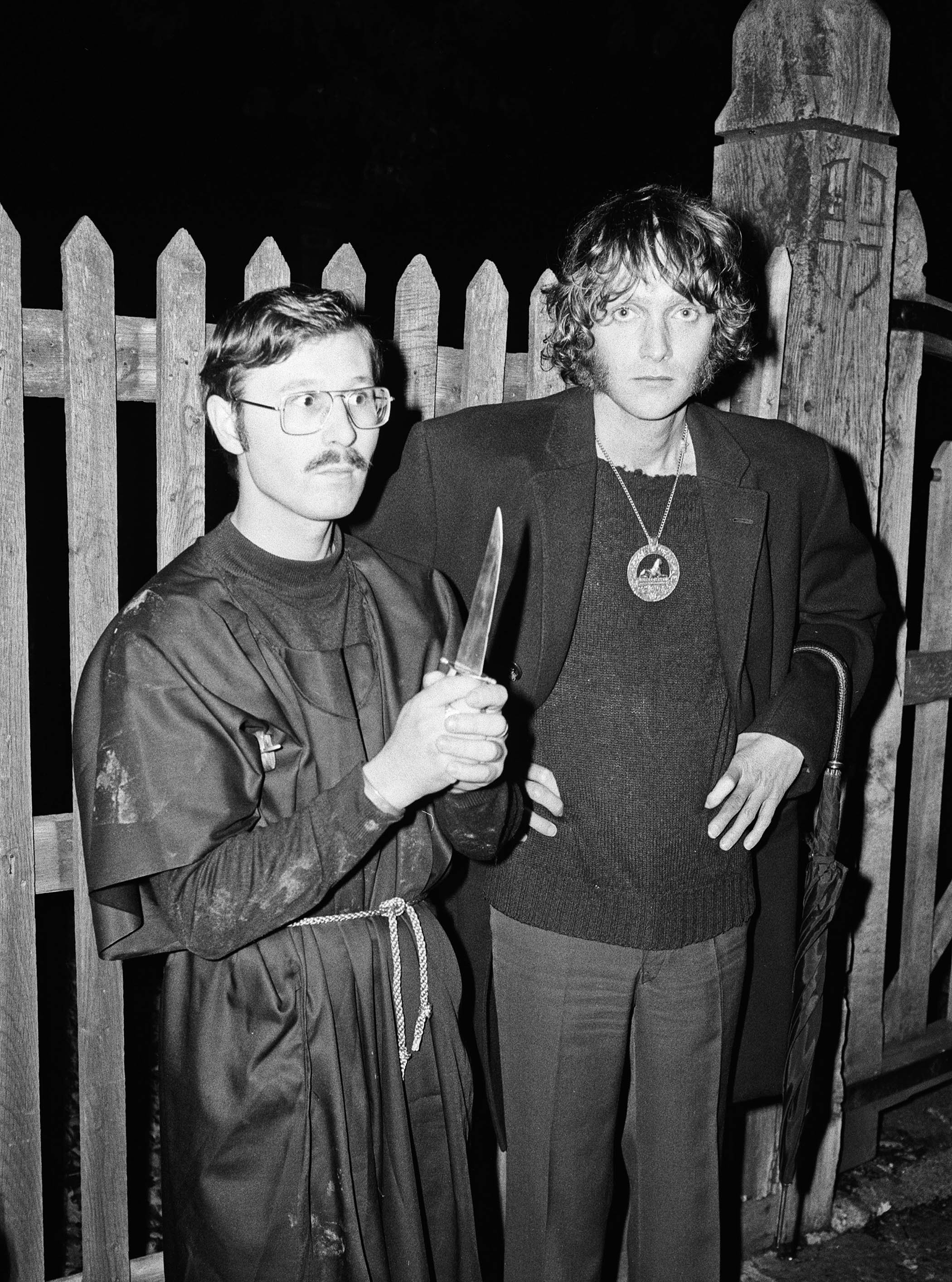
Farrant did not create the Highgate vampire. That was the work of his friend Seán Manchester, a photographer from Nottinghamshire, then 25, and another young man who, like Farrant, was a well-known face on the tight-knit north London paranormal scene; the apparition was no harmless ghost, Manchester told the Ham & High. He instead theorised that it was “King Vampire of the Undead”, a medieval nobleman who had been buried on the site the Victorians had chosen for Highgate Cemetery. “We would like to exorcise the vampire by the traditional and approved method,” Manchester told the paper, “drive a stake through its heart.”
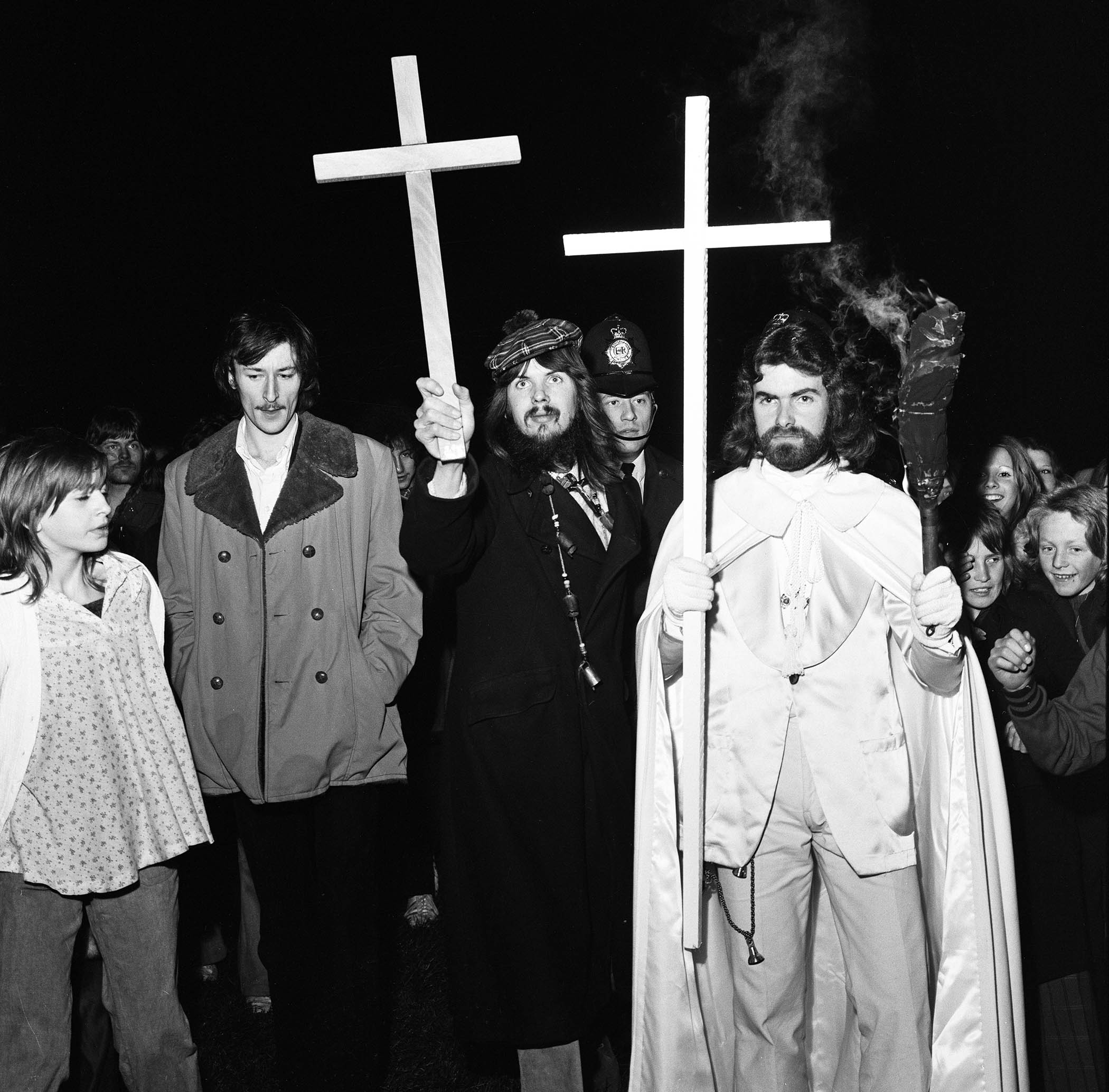
Farrant and Manchester were regulars at the Woodman pub at the bottom of Muswell Hill Road. Though different in appearance and temperament – Farrant was willowy and garrulous, clad in frilly shirts and drainpipe trousers; Manchester, thicker-set and self-serious in flowing capes and natty bow-ties – the two men shared a flair for publicity. If Farrant was initially reticent about the vampire claims, Manchester – who boasted of a direct lineage to Lord Byron – was adamant.
In a series of increasingly sensational interviews, both men declared that they alone could expel the entity from Highgate Cemetery. When Manchester announced he would be holding an “official” public vampire hunt on Friday 13 March 1970, ITV sent a crew to cover the event. Hundreds of self-professed vampire hunters descended on the cemetery from across the UK, overwhelming the police cordon stationed at the gates. Dozens of graves were desecrated, along with significant damage to the catacombs at the top of the site. “Satan riddle of open tomb” screamed the most memorable of the next morning’s headlines. The accompanying photo shows a crowd of excitable-looking young men scaling the cemetery walls.
That August, a headless corpse was discovered near its grave plot, having been dragged out of its coffin. Weeks later, Farrant was arrested for “vampire hunting” in the cemetery while carrying a crucifix and wooden stake. The case was dismissed in court, though the BBC later filmed him cheerfully recreating his night-time visit. Over the following months, Farrant and Manchester’s relationship began to fray. Neither man, it appeared, wished to relinquish control of the vampire narrative. In 1973, matters came to a head when both parties advertised a “magical duel”, which was to take place on Parliament Hill in Hampstead (the event was called off at the 11th hour).
Farrant’s legal troubles were not over, however. A year later, he was convicted of grave desecration and sentenced to five years in prison. Though he always denied the charges, he did admit sending voodoo effigies to two police officers. On his release two and a half years later, he settled in Muswell Hill, where he remained for the next four decades, his flat becoming a regular pilgrimage site for Highgate vampire aficionados, journalists and film-makers.
Manchester’s trajectory was perhaps even stranger. In the 1980s, he moved to the south coast, referring to himself as a bishop in a mysterious organisation called the Old Catholic Church. In his 1985 book The Highgate Vampire, Manchester outlined the story of how he eventually vanquished the undead ghoul stalking north London in the cellar of a gothic mansion on the border of nearby Crouch End in early 1974. “With a mighty blow, a sharpened shaft of wood impaled the creature’s heart. We witnessed the body shell cave in and quickly turn filthy brown and that itself soon became a sluggish flow of inhuman slime and viscera in the bottom of the casket.”
This was, Manchester later wrote, the first of dozens of similar slayings he undertook (several critics have noted his account’s striking line-by-line similarities with Bram Stoker’s Dracula). By the mid-1990s, Manchester had began signing off correspondence as the “Bishop of Glastonbury”, appearing regularly as a talking head on paranormal debates on the BBC and commercial radio phone-ins.
The passing decades did nothing to soothe the enmity between Manchester and Farrant. Both men were early and enthusiastic adopters of the internet, which allowed them and their respective supporters to exchange creative insults at will.
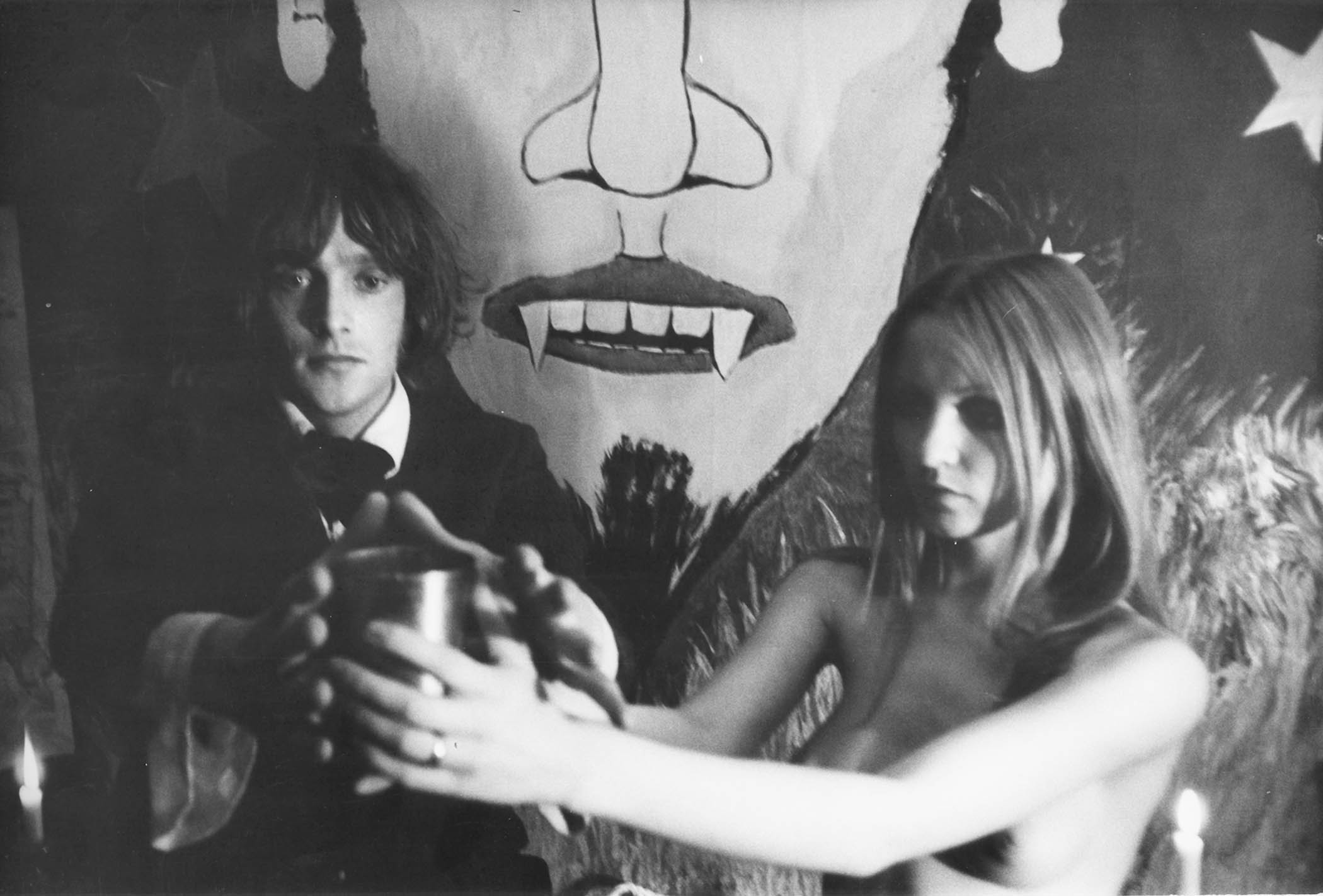
To Manchester: “Farrant might make an interesting case study for the psychiatrist in search of a project concerning narcissistic personality disorders, or a priest specialising in the examination of demonic possession brought about by compulsive dabbling in pseudo-occultism for publicity.”
Farrant’s supporters, meanwhile, claimed: “[Manchester] is [a] bitter old pensioner who spends all his waking hours perpetuating [the feud] from his study in Bournemouth. And when he’s not busy doing that he is stalking, trolling and intimidating his critics.”
In the early 2000s, Farrant launched his own website, which offered a forum for paranormal debate and investigation, as well as minutely detailed blogs on daily life, cumulatively running to hundreds of thousands of words. “Bishop Bonkers” was always a favourite topic, along with a spirited denial that a vampire ever walked in Highgate.
Manchester has been even more prolific, across blogs and comment sections, defending the existence of the Highgate vampire and his own dramatic role in its slaying. As for Farrant, “there is something unpleasantly toxic about this mild-mannered, nervous, stammering creature whose stoop, combined with what appears to be an advanced stage of anorexia, puts one in mind of …Dickens’s Uriah Heep”.
Those who have questioned Manchester’s ecclesiastical credentials have also been quick to feel his ire and threats of legal action. The attritional cyberwarfare between Farrant and Manchester has plausibly been described as the world’s longest-running online feud.
Ifirst came across the Highgate vampire on a Saturday afternoon in early 2019. Browsing in Foyles in Charing Cross Road in central London, I’d picked up Occult London by Merlin Coverley, a slim book promising an accessible history of the city’s best known paranormal legends. In truth, its central question – did a vampire stalk Highgate Cemetery for a brief few weeks in 1970 – was of relatively little interest to me.
Instead, I was drawn to the men whose feud had propped up the story for half a century. Highgate Cemetery, now a Grade I-listed heritage site and global tourist attraction, does not publicise the association. If tourism is highly encouraged – there are regular coachloads of visitors to Karl Marx’s tomb – curious paranormal visitors are not.
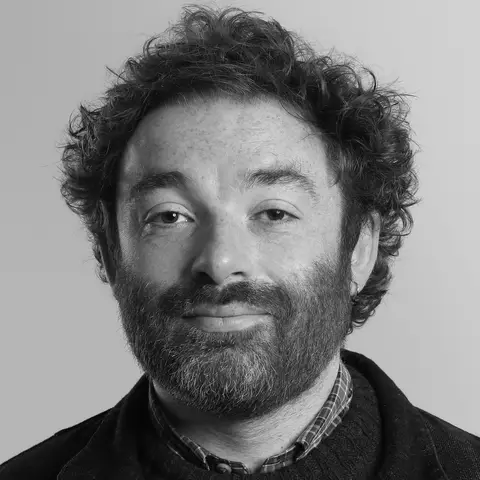
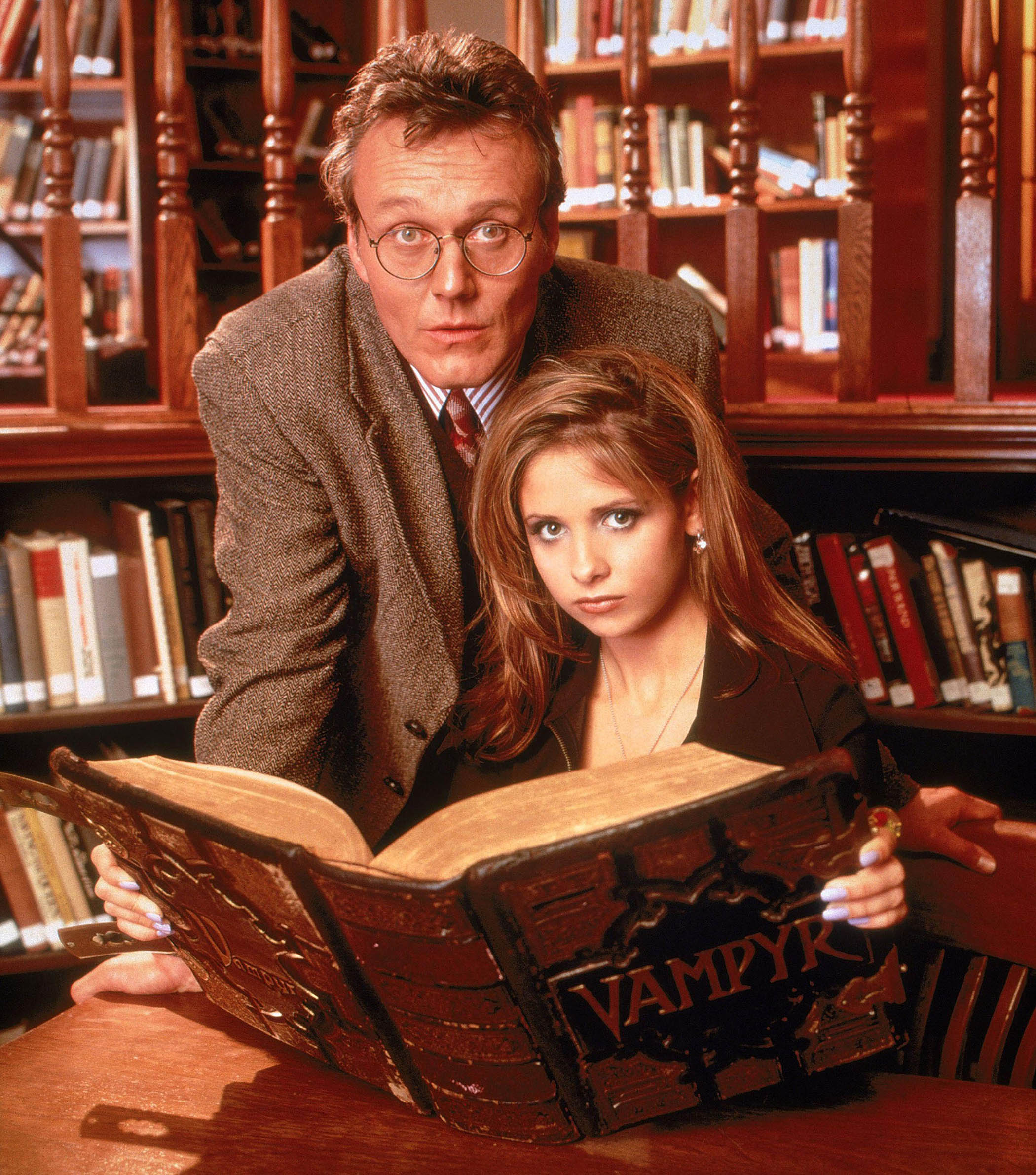
The legend of the Highgate vampire, however, refuses to die. It has proved irresistible for new generations of writers, inevitably cropping up in Buffy the Vampire Slayer (the titular character’s mentor Rupert Giles, the story goes, had nearly been killed by the Highgate vampire in 1972); it appears in a cult Italian comic book series and in one of JK Rowling’s Cormoran Strike novels, The Ink Black Heart, which uses the cemetery and legend as a backdrop. For paranormal enthusiasts, the story continues to provoke regular bouts of earnest investigation. David Milner is an avuncular, lifelong north Londoner in his late 60s. Milner, a photographer, first met Farrant in the mid-1990s, after working on a series of videos for a local goth band with a keen interest in the Highgate vampire. “[Farrant] sent me an email, as he’d got wind of it. [He] was a really kind man. Not argumentative or anything like that,” Milner told me over the phone. He became a regular visitor to Farrant’s flat. “His lifestyle left a bit to be desired. He smoked and I didn’t. There were piles of books all over the place. [But] other than that, yeah, he was very nice.”
The two men collaborated on the 1997 film In Search of the Highgate Vampire. A cult classic on release, it has since attracted an ever-growing audience on YouTube. Milner, eventually the designated official photographer for Farrant’s British Psychic and Occult Society, is unembarrassed about his own paranormal beliefs. Had he ever seen anything near Highgate Cemetery, I wondered.
“Yes, I have. It was in Queen’s Wood [on the way to Muswell Hill]. This was back in the late 70s. I was walking [with] my father. We had a small dog [and] it was running around …” With spooky timing, Milner’s mobile data ran out before he had a chance to finish these recollections.
Farrant died in April 2019, aged 73, after several years of ill-health. Manchester posted a eulogy on Facebook. “Suffice to say, I feel sadness at him shuffling off this mortal coil before we could meet one last time,” he wrote. “Though he might not want my prayers he has them anyway. May he rest in peace.”
Such apparent magnanimity is not the whole story, according to Farrant’s widow, Della, his third wife. Manchester had also allegedly taken to trying to obtain the death certificate, presumably just to be sure, as well as posting conspiracy theories about David’s final illness. “I get vampire fatigue. Our lives were about so much more than that,” said Della. Imagine, she added, having Manchester as your third wheel.
I’d reached out to Manchester with an interview request in late 2019, which was briskly turned down. Instead, I would be allowed to submit a series of written questions to be perused at his leisure. Simplicity, I thought, was probably the best policy, with four straightforwardly factual questions about the Highgate saga and its legacy. Manchester’s responses were florid and self-important. He was not merely unhappy with something I wrote – including his answers – he was livid. A lengthy rebuttal was posted on Facebook, which took aim at what he saw as a long list of unforgivable errors. I had read his work with insufficient attention, he said, and treated my questions as though they were offensively superficial and borderline moronic.
“Consequently,” Manchester wrote, “the article he has produced is riddled with innuendo [and] misinformation.” Prominent among them was the contention that Manchester was a “self-proclaimed” vampire hunter and bishop. “This is how I was accurately described by academics, authors, researchers, interviewers and the media generally over the last half a century,” he thundered. “I did not proclaim myself as such. I had no need.”
I had got off lightly. A legion of sources who had contacted Manchester over the decades suggested he was capable of stubborn, often reasonably creative, malice. It wasn’t just Farrant’s associates who had suffered.
Anthony Hogg is the Melbourne-based founder and president of the Vampire Studies Association, established 2018. Like so many others, his interest in the bloodthirsty undead dates from childhood. When we spoke last month, he explained how he had once looked up to Manchester, seeing him as the closest it was possible to get in real life to a monster hunter such as Stoker’s Van Helsing.
In the late 2000s, Hogg was pursuing his own research into the Highgate vampire when a series of anonymous online commentators began attacking him by name. “That was scary. I’d never encountered anything like that before.” He had strong suspicions that Manchester might be behind it. When contacted about this suspicion, Manchester said the suggestion was “beneath contempt”.
On a crisp Friday evening in October 2024, I travelled to a nondescript pub on the outskirts of suburban south-west London to meet Jamie Farrant for the first time. We had been introduced by a source and, truthfully, I wasn’t sure what to expect. Unlike his father, the younger Farrant did not appear to have much in the way of an online presence. Clad in sensible denim, Jamie Farrant did not quite conform to my expectations of how the son of a notorious occultist might present to the world.
His father was an easy man to get on with, he told me. Their meetings soon became a fortnightly fixture, with Jamie driving from the south coast to north London. He found himself drawn ever closer into his father’s world. In the early years of their relationship, Farrant Sr would attend lectures and events across the country; his son would accompany him as an enthusiastic driver and chaperone. The Highgate vampire was still a box office draw in the world of the British occult.
Do you think he ever got tired of it? I asked Jamie earlier this summer.
“Oh no,” he laughed. “He loved it. Every minute of it. Always the showman. He’d be sitting with a glass of wine, [waiting] for people to come up and ask him questions about it all.”
Jamie felt proud to have a dad who commanded such attention, but he is honest with himself. Though he knew his father cared for him, he understood that nothing would ever come close to his attachment to the glory days of the Highgate vampire. “It took over his life. It was the biggest [thing] for him by a country mile … You couldn’t meet my dad without the Highgate vampire being involved.”
I wondered if he had ever wished for a more ordinary father?
It wasn’t like that, Jamie replied. “I said this at his funeral. If he’d been a plumber, we wouldn’t be here talking about him now, would we?”
The online vitriol from Manchester began shortly after father and son had reconnected. “I’d messaged Manchester to say: ‘I’ve seen your name in connection with my dad. I was just wondering what he’s like.’ That was a silly thing to do. I got a four-page email back calling [my dad] a charlatan – and it just got worse from there.” Defending his paternal honour meant becoming an enthusiastic combatant in the long-running Farrant-Manchester online war. “I used to enjoy prodding him with a stick and watching him react,” Jamie acknowledged.
Still, over the course of several interviews, the only time I saw Jamie express anything that could be described as rancour was when he spoke about the immediate aftermath of his father’s funeral in 2019. “[Manchester] posted that it was a shame my dad didn’t have a chance to seek his forgiveness. I regret not going back and writing: ‘He didn’t want or need it. You’ve spent your whole life trying to make his a misery.’”
The endlessly fertile online universe cultivated by Manchester still exists, albeit in diminished form. Of his innumerable blogs and anonymous attack-dog accounts, almost all have expired, save for a regularly updated YouTube channel. Its content veers towards the avant garde, with dense visual essays on the Highgate vampire jostling for attention with moody reflections on the search for the holy grail and obituaries for various cultural luminaries of the 1960s.
On LinkedIn, his profile boasts recommendations for “exorcisms” and “healing”. It is where he chose to reply to my latest interview request earlier this month. Instead of directly responding to written questions, he instead shared a link to a video titled My Last Word. Backdropped by a picture of a windswept Manchester, clad in dog collar, it offers a 38-minute reflection on his great rival. “I knew him as well as anybody could at the important period at the time,” Manchester says. “I knew him better than his own son … I knew him well enough to know [that] he was not serious. That he did not believe in either ghosts, vampires or anything else. But he did believe in self-publicity and he achieved it to some degree.” Contemporary commentators, Manchester sighs, only use what is useful to them, with scant regard for the truth. “Their agenda is not the truth but what attracts interest.”
It is difficult to precisely calculate the half-life of any urban legend, even one as persistent as the Highgate vampire. As its flag-bearers die or reach advanced old age, there are no guarantees that succeeding generations will pick up the mantle. On a boiling afternoon in late summer, I travelled to Highgate Cemetery to take in one of its regularly scheduled tours.
Our guide was a personable woman in her early 60s, who offered an engaging rundown of its official history of grandeur, decline and resurrection. So it was a surprise to hear her ask the cosmopolitan, resolutely middle-class group of American and European tourists if they knew the legend of the Highgate vampire – a relic of the cemetery’s darkest days.
Even more so, the dozens of hands from around the world enthusiastically shooting up in the affirmative.
Photographs by Della Farrant, Mike Lloyd & Bunny Atkins/Daily Mirror via Getty Images, BBC, Alamy