
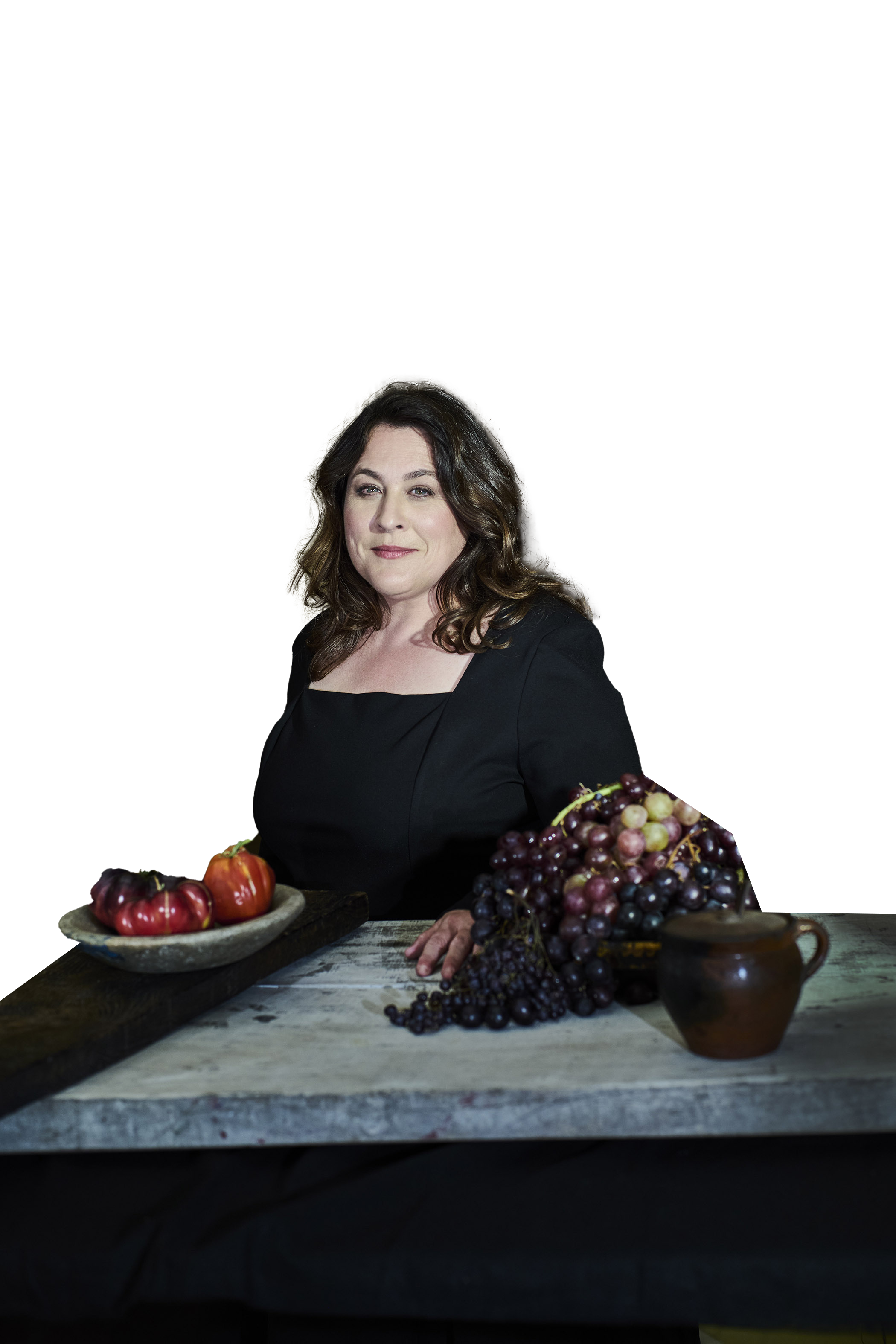
Tanya Gold, our new restaurant critic on feasts and family
Chu Chin Chow in Hampton Court, which is still there. Weeknight suppers were at Superfish in East Molesey, which is also still there. Weekend suppers were at the New India in Norbiton – gone but not forgotten – or at Paradise, the Indian restaurant in Hampstead. I am dependent on dining out. I spent my student loan at the Le Manoir aux Quat’ Saisons, which was idiotic, but I had ambition. When I left London for Cornwall 10 years ago, the Paradise staff gave me a box of chilled After Eights because I was so devoted a customer, which is something I’m proud of.
I have tried cooking, but I lack the patience: it isn’t my art form. I once tried to make toffee by melting butter and sugar in a pan. It tasted of vinegar, which told me everything.
I do not go to restaurants for food; or not just for food. To paraphrase Hannibal Lecter, a great restaurant critic lost, the food is incidental. Anyone can fry meat; anyone can peel an apple. Chefs know this. In her kitchen at the Connaught Hotel, the French chef Hélène Darroze once told me that her favourite food was a boiled egg. Six Michelin stars in and I believed her.
Instead, I go to restaurants to feel something: vitality, mystery, but most of all love. In a restaurant, that is what you buy – a manqué of romantic or parental love – and you control it from your table and pay the bill, and a great restaurant will charge a fair price for it. I treasure all sorts of restaurants, from palaces to sandwich shops, and the thing they share, for this neurotic eater, is the judicious application of love and fat. Simply put, they feed me.
I like childish foods, because I have never grown up. I appreciate sophisticated foods, but they do not stampede to my subconscious so swiftly or happily. I used to think Cadbury’s Mini Eggs were the apogee of human achievement, but I had fallen out of love with Cadbury’s Mini Rolls by then. I was 30. I have visited the Cadbury factory in Bournville and it is greyer than you might think, though I was thrilled to see Wispa written on a wall, like a direction. The only restaurant I mourned not visiting – I couldn’t get a table – is the Creme Egg Café in Soho, a 2016 pop-up, though how they could improve the Creme Egg I do not know: certainly not with toast, though I heard they tried it. The haute-cuisine cream egg I ate during the Scrumdiddlyumptious Afternoon Tea at One Aldwych, the famed Covent Garden hotel, is still the best thing I have tasted, but I love sugar. I treat pastry chefs with the same reverence others reserve for nurses.
I still think it’s hard to beat the right jam sandwich: cheap white bread only, any unsalted butter, very good jam always. I like buns and sweets and animal fats; as much good beef as I can eat; the right pork sausage, cooked for as long as an empire takes to fall; cheese of every kind so long as it is rich; spaghetti. Eating bloodied boiling tomato from the corner of a lasagne dish with a teaspoon – always a corner, always with a teaspoon – is transformative if your school food is so dull you remember the crockery better than what was on it. My school wasn’t quite Lowood from Jane Eyre, but they did give me a napkin ring to civilise me. I was four.
delivered the food in procession with torchbearers and… a violinist! I loved Carr’s Fish Shack, on the north coast of Jamaica. We found it on our honeymoon in 2012, on the beach in ruins after a hurricane, being repaired as we arrived: it is still the only demolished restaurant I have eaten inside.
What’s on the menu, I said.
Carr walked to his boat and pulled out a red snapper, still on the line. He steamed it over charcoal with scotch bonnet. It was the only dish he served, nothing came with it – to be fair, it needed nothing – and it cost £50. I respected the confidence of the pricing, which matched London, Paris and St Ives. It was worth it.
Perhaps the hole-in-the-wall near the Damascus Gate in the Old City of Jerusalem is less rare, but I love that, too. The falafel is deep-fried in front of me and the owner pretends to remember me though I know he doesn’t, and I appreciate the courtesy. I love Aunty May’s in Newlyn, whose warm scotch eggs are the platonic ideal, and who taught me to pair red onion with egg mayonnaise in a breakfast sandwich; and the Coffee Cup in Hampstead for its spaghetti al pomodoro and fresh lemonade. Some restaurants are homes that are always happy. You just need to walk in.
I like spectacle, too. My favourite restaurant in London used to be Rules, on Maiden Lane, but I think Brexit spoilt it for me. It is a restaurant from Edwardian fiction: red and gold like a sovereign, with an alarming painting of Margaret Thatcher as Britannia on the wall. It looks like Brexit would look if it were a restaurant. (Political restaurants are fascinating and almost always terrible. The death of the Gay Hussar, the Hungarian restaurant preferred by Labour Party hacks, at the midpoint of the Corbyn experiment, was telling; it is now a Noble Rot.) There are tables for one at Rules. James Bond plotted in Rules in Spectre, though I don’t think he ate anything, which was foolish of him. I had my wedding breakfast there: beef on the bone, yorkshire pudding as big as your head, golden-syrup pudding with custard. It is unusual to find golden-syrup pudding in London: I have only found it elsewhere at Scott’s, on Mount Street. Only eton mess can hold as much sugar in a bowl.
I notice food wherever it manifests. When I look at Caravaggio’s Supper at Emmaus I stare at the chicken. When I look at Rembrandt’s Belshazzar’s Feast I want the grapes. Winston and Julia’s bedroom picnic in 1984 – a book I read every day at school, for meditative purposes – bewitched me, because it is the ultimate consolation of food. You can live under a tyranny that will take everything, including your soul, and yet there is, Orwell told us, carefully: real white bread, sugar, jam and chocolate. A jam sandwich, then, and presumably sex. PG Wodehouse wrote more glibly – this is about Simpson’s-in-the-Strand: “What Cosmo wanted was roast beef, smoking hot, with yorkshire pudding and floury potatoes on the side, followed by something along the lines of roly-poly pudding and stilton cheese.”
I encourage an internal reality where I eat porridge in the Grand Divan at Simpson’s each morning and cake in Fortnum & Mason’s Diamond Jubilee Tea Salon each afternoon. It is the best tearoom in London, though I have never forgotten eating a cake disguised as a very small trenchcoat at the Berkeley. It was London Fashion Week; perhaps customers would only eat cake if they thought it was a piece of clothing. These restaurants all tell me I have the taste in food of a fictional Edwardian ghost child and that I have, alongside everything else, eaten the British class system. I thank the napkin ring.
ever eaten. It was at Thomas Keller’s Per Se, above Columbus Circle. Perhaps it was my fault: I chose the vegetarian tasting menu, which is always a mistake. The food was tiny and monied, like the people eating it. I didn’t mind that, but the service was bad. I sensed they wanted me to emit gratitude for dining in this over-formal room with what looked like an oar on the wall. It was neurotic dining and it was not my neurosis. The chef is a stressful man, I thought idly – I am eating his stress and I don’t want it. What I wanted was spaghetti.
I also went to the Chef’s Table at Brooklyn Fare, where they wouldn’t let me take notes – was I, in fact, an industrial spy? The diners, though seated close to one another at the counter, did not speak to each other, because they had paid too much money for the jeopardy of a conversation with a stranger. I was fascinated by them and I pitied them. I wonder if they got what they wanted, which was status among people as deluded as they were. Food can do almost anything: there are many kinds of consolation, and love. As your critic I will bring you the best kinds.
I am not just a child. I am interested in food taken to the limits of its possibilities. The Berkeley trenchcoat cake – there was also an umbrella and a jacket, though no shoes – showed me that. I am stunned by dreamworlds that fly out of kitchens: the courage and vulnerability that made them. I loved Ollie Dabbous’s Above at Hide, on Piccadilly, for its feathers and bone and its view of the No 22 bus route: the sacred and profane together. I cried at Heston Blumenthal’s Fat Duck, which I will write about in this magazine soon. But even at the most gilded restaurants – Massimo Bottura’s Osteria Francescana in Modena, for example, twice at the head of the World’s 50 Best restaurants list – I find myself thinking: let’s see your lasagne then. The one you eat at home.
I am also bewitched by spectacle – when you cannot look inwards, look outwards. You can read civilisation – and its ebbing – in restaurants. I love the victimhood of the current group of oligarch palaces. I would never eat in them by choice – I am not a woman for a handbag chair (a chair that is for your handbag) – but they are fascinating. Bacchanalia in Mayfair is the Emperor Nero’s Bella Italia. The Lobby at the Peninsula is Emperor Nero’s Carnival Cruise Line. Lilibet’s, also in Mayfair, is Elizabeth II’s stolen childhood, with weird fish and overwrought cream cake. These restaurants are so bad they give me hope, because if you can’t make a restaurant perhaps you can’t make a tyranny. This is the food of an elite with less taste than any elite before it – the elite of the computer age. Their insanity manifests as maximalism. The interiors at Carbone, which feels like not one but many restaurants, are mad.
All this, restaurants can do. They are as varied as us, because we made them, and they are as good a guide to what we want and fear as anything.
the playwright Peter Tersen, hung on the wall. As a child I thought the painting was an infinite restaurant, a hundred stories high. There were people eating and dancing on the ground floor; but above them there was a couple on a bed, turned away from each other, sullen and parted.
I went back to Spaghetti Junction a few years ago, or what remains of it. Franco’s children opened Shambles to succeed it, which is as thoughtful a restaurant as I have found anywhere. Franco’s son Massimo showed me old menus and photographs of Spaghetti Junction. But it was the painting that bewitched me, still: brighter and more vivid than ever. I realise now I misunderstood the painting. It wasn’t just a restaurant, I just thought it was. I confused the infinite variety of life with a space in which to eat. Everyone has a Rosebud. This is mine.
Fashion assistant Freya Goodchild-Bridge; photographer’s assistant Alfie Bungay; hair and makeup by Krystle Gohel; food styling by Katy McClelland. Cream dress by Arrange from Asos; black dress by Arrange from Asos; navy dress by Kemi Telford